
Ask three doctors which cervical cancer test a camp should offer and you may hear three different answers. Each will be partly right.
The most accurate test on paper isn’t always the one that works on camp day, with one hall, a few hours and women who may never come back. Pick wrong and a result gets lost somewhere between the camp and the lab.
The three tests, in plain terms
VIA (visual inspection with acetic acid)
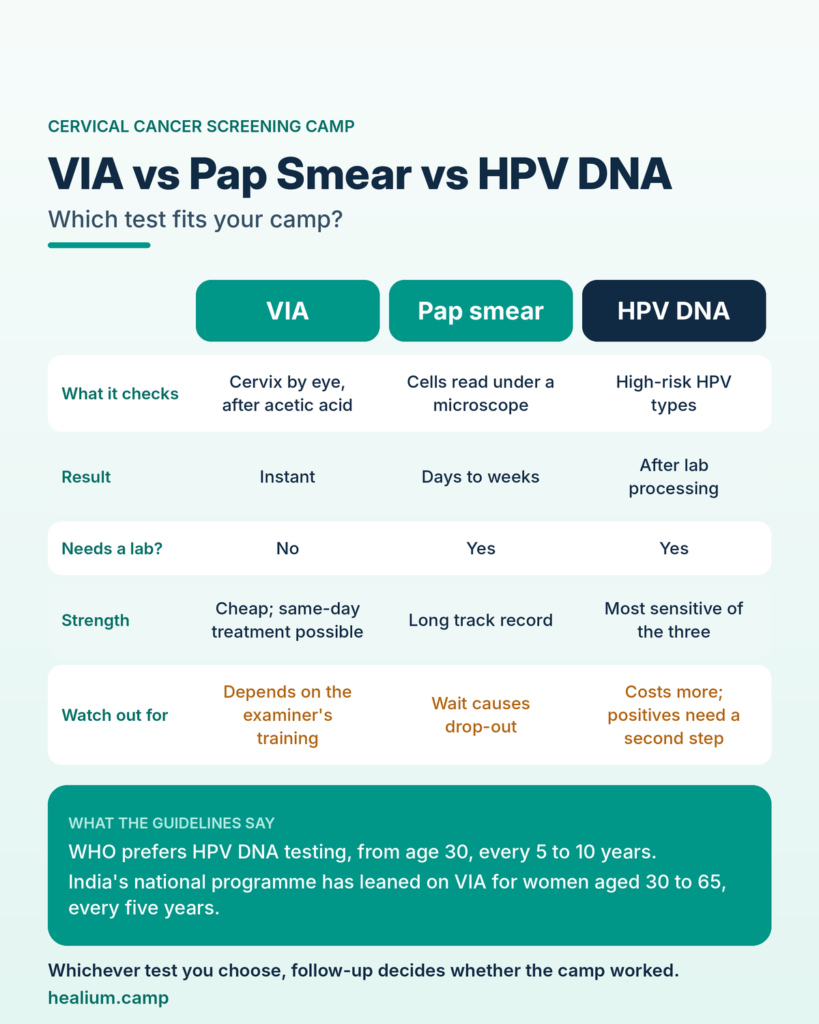
A trained health worker applies dilute acetic acid to the cervix and checks for white patches by eye. It’s cheap and the result is instant, so treatment can happen the same day. The catch is that it depends on the person looking, and accuracy varies with training.
Pap smear
Cells from the cervix go to a lab, where a cytologist reads them under a microscope. It has a long track record, but it needs trained lab staff and results take days or weeks. For a one-day camp, that wait is where many women drop out.
HPV DNA test
This test looks for the high-risk HPV types behind mostcervical cancers rather than for cell changes. It’s more sensitive than VIA or Pap and doesn’t rely on anyone’s eye. It costs more and needs lab processing, and a positive result needs a second step to find who needs treatment.
What WHO and India recommend
WHO prefers HPV DNA testing over VIA and cytology, starting at 30 and repeating every 5 to 10 years for most women. India’s national programme has leaned on VIA for women aged 30 to 65, once every five years, since it can be done at a primary health centre without a lab.
So which one fits your camp?
With a lab partner and a clear referral route, HPV DNA is the stronger first test, with VIA or another method to sort out the positives. Without them, VIA by trained staff is practical, as long as women who test positive have somewhere to go. Pap is the hardest to fit into a single-day camp.
Whichever you choose, follow-up decides whether the camp worked. In one Tamil Nadu evaluation, only 74 of 807 women referred for further tests turned up.
Questions to ask before you pick a test
Before the camp is booked, it helps to settle four things on paper:
- Who will perform the test, and how recently were they trained?
- Where do samples go, and how quickly do results come back?
- Who treats a woman who tests positive, and where?
- Who tells each woman her result, and how?
Many programmes stumble on that last question. Women are often never told what their result was or what symptoms to watch for, so a normal result and a missed one look exactly the same to them.
Getting women to the camp in the first place
Even the right test fails in an empty hall. Low awareness, stigma and the difficulty of travelling or taking time off keep many women away. A familiar local health worker explaining what the test involves, in plain language and ahead of the day, helps. So does privacy on the day itself.
Screening is meant for women between 30 and 65, so invitations should say that clearly. Otherwise the queue fills with women outside the age group the guidelines prioritise.
Planning one? Book a Camp and bring cervical cancer screening to your community.
Frequently Asked Questions
Which cervical cancer test is the most accurate?
HPV DNA testing is the most sensitive of the three. VIA and Pap smear can miss more pre-cancers, depending on who performs them.
At what age should women start screening?
WHO advises starting at 30 for most women, and at 25 for women living with HIV.
Is a Pap smear still worth doing?
Yes, where a good lab and a follow-up route exist. It’s just harder to run in a one-day camp.
What happens after a positive result?
A positive screen isn’t a diagnosis. Women are usually referred for a closer check, such as colposcopy, and treated if pre-cancer is found.