Here’s a number worth sitting with: Tier-2 and Tier-3 cities now account for 62% of all new health insurance policies sold in India – overtaking metros as the primary demand centres.
Health awareness in smaller cities is rising. But awareness without access to detection is an incomplete equation. And that’s exactly the gap that structured health screening programmes are now being designed to close.
Where the Disease Burden Actually Lives
The assumption that India’s most serious preventive healthcare gaps exist in remote villages is only partially true. A large and growing share of undetected chronic disease sits in Tier-2 cities, industrial townships, and semi-urban belts – places with some infrastructure but no structured screening ecosystem.
A textile worker in Surat, a logistics employee in Nagpur, a construction crew in Raipur – these populations carry high exposure to diabetes, hypertension, anemia, and occupational health risks. They are not remote. They are simply not being reached by preventive care in any organised way.
This is where the health camp model has its clearest, most immediate use case.
The Healium Camps Approach to Non-Metro Deployment
At Healium Camps, we don’t treat Tier-2 and industrial locations as secondary markets. They are the primary focus of how we’ve built our operational model.
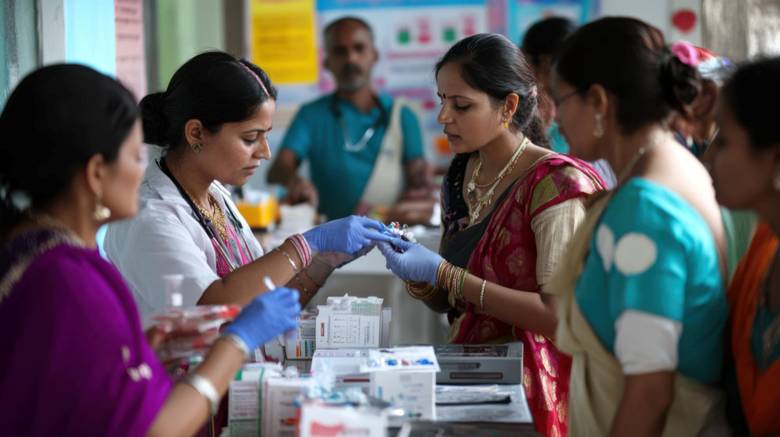
We screen communities where they live, learn, earn, pray, or play – which in practice means factory floors in Chhattisgarh, housing societies in Nashik, Gram Panchayats in Rajasthan, fire stations in Mumbai’s outskirts, and school campuses in Karnataka. The venue changes every time. The standard of care doesn’t.
What makes this possible is that we don’t fly in a central team. Every health camp we run is staffed by locally onboarded professionals – MBBS and BAMS doctors, lab technicians, phlebotomists, ASHA workers, community pharmacists, and paramedics – all coordinated through the Healium Camps app. Local presence means faster deployment, lower costs, and teams that understand the community they’re serving.
This is especially critical in Tier-2 and industrial settings, where a worker may not visit a clinic for months after a camp. At Healium Camps, real-time results mean our doctors don’t just detect – they consult, prescribe, and dispense within the same visit. A factory worker in Raipur screened for diabetes and hypertension on the same day doesn’t just receive two numbers on a slip. If the result warrants it, they receive a doctor’s consultation, a prescription, and up to 30 days of medication before they return to the production floor. That’s the difference between a screening event and a healthcare intervention.
Programmes Particularly Relevant for Industrial Populations
Different workforce populations carry different risk profiles. Our health screening programmes are modular – organisers pick the combination that fits their beneficiary group. For Tier-2 and industrial settings, the most commonly deployed include:
Diabetes and Hypertension Screening – together, these two conditions affect hundreds of millions of Indians, most undiagnosed. At our medical camps, results are instant and on-site medication is dispensed where applicable – no hospital visit required.
Anemia Screening – prevalence of roughly 60% among women and children makes this one of the highest-need programmes across any non-metro population. Result in 20 seconds, iron supplementation within 5 minutes, up to 2,000 beneficiaries per team per day.
Vision Screening – India has over 270 million people with vision impairment, and factory and logistics workers with uncorrected vision are a productivity and safety risk. Our optometric programme screens and dispenses pre-numbered glasses within 5 minutes, up to 1,500 screenings per team per day.
Obesity Screening – beyond BMI, our programme screens body fat percentage, visceral fat, muscle mass, HbA1c, lipid profile, and heart murmurs – a full metabolic picture that industrial employers increasingly require for workforce health data.
Drugs of Abuse (DOA) Screening – a 14-substance urine panel with results in 5 minutes, now standard in responsible industrial CSR programmes.
Latent TB Screening – in dense workforce housing and factory settings, undetected TB transmission is a real operational risk. Population-level health camps intercept it earlier than facility-based testing.
Real-Time Data Across Every Location
For industrial CSR and ESG programmes, documentation matters as much as delivery. Our Healium Camps Ecosystem – a web portal and mobile app – captures every camp’s data live. Sponsors managing camps across Assam, Gujarat, Maharashtra, and Chhattisgarh simultaneously access one dashboard, not three separate Excel reports.
Reports are audit-compliant and filterable by disorder, location, date, and beneficiary count. As we progress our ABDM (Ayushman Bharat Digital Mission) integration, every screening record moves toward being part of a verifiable national health identity – regardless of whether the camp was held in Mumbai or Morbi.
The industrial and Tier-2 belt of India is not underserved because of geography. It’s underserved because the right operational model hasn’t been there. That’s the gap health screening programmes like ours are now systematically filling – one district at a time.
Frequently Asked Questions
Q1. Why are Tier-2 and industrial regions a priority for health screening programmes? These populations carry high chronic disease burden – diabetes, hypertension, anemia, TB – with little to no access to organised preventive screening. The risk exists; the infrastructure hasn’t.
Q2. How does Healium Camps deploy health camps in non-metro locations?
Through locally onboarded field teams coordinated via the Healium Camps app – no central team travel required, which keeps deployment fast and costs low.
Q3. Which screening programmes are most relevant for industrial workforces? Diabetes, Hypertension, Anemia, Vision, Obesity, Latent TB, and DOA Screening are the most commonly requested for industrial and Tier-2 settings.
Q4. Can a single health camp cover multiple programmes in one visit?
Yes. Our modular programme design allows organisers to combine multiple screenings in a single camp – a worker can be screened for diabetes, hypertension, vision, and anemia in one sitting.
Q5. How do organisations access camp data and reports?
Through the Healium Camps Ecosystem dashboard – live data, audit-compliant reports, filterable by location, disorder, date, and beneficiary count.
Q6. What is the screening capacity at a Healium Camps health camp?
It varies by programme – anemia handles up to 2,000 per day, vision up to 1,500, diabetes up to 500. Multi-programme camps are sized based on expected footfall.
Make your workplace healthier with Healium Camps’ health camp solutions – Get details.