Most people who attend a medical camp see the surface: a registration desk, a queue, a test, a result. What they don’t see is the operational architecture that makes it possible to screen 500 to 2,000 people in a single day – accurately, with instant results, and with full documentation – in a venue that may have no prior medical infrastructure.
Here’s what actually goes into it.
Before the Camp: Setup That Determines Everything
A high-volume health screening camp doesn’t begin on the day. It begins with venue assessment, team assignment, equipment logistics, and programme finalisation – all coordinated through the Healium Camps Ecosystem before the first participant walks in.
Venue requirements are deliberately kept simple – tables, chairs, standard plug points, adequate lighting, a nearby washroom, and queue management volunteers. This means camps can run in factory canteens, school halls, community centres, open grounds, and Gram Panchayat buildings – not just hospital premises.
Equipment for each programme travels with the team. A diabetes screening camp brings HbA1c analysers and RBS devices. A breast cancer screening team brings the Thermalytix® imaging system. Vision screening brings auto-refractometers and pre-numbered glasses inventory. Cardiac screening brings 12-channel ECG machines with remote specialist connectivity.
Each team is assembled from the local professional pool – onboarded through the Healium Camps app – so the people who arrive know the equipment, know the protocol, and know the community they’re serving.
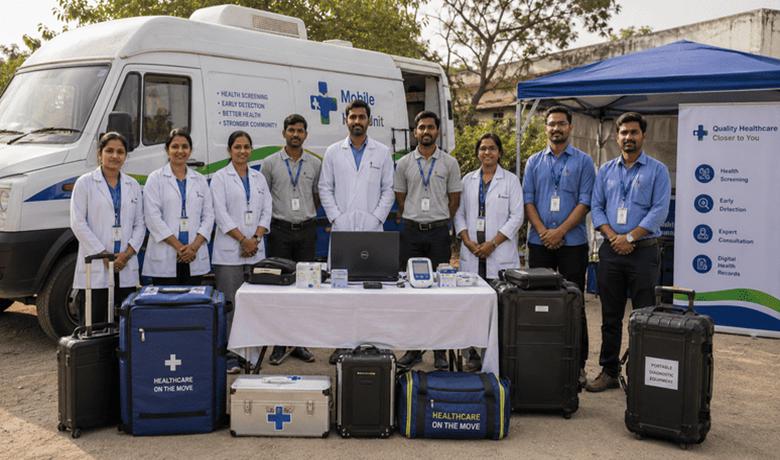
The Team Composition for a Multi-Programme Camp
A high-volume camp running multiple health screening programmes simultaneously is staffed in layers – each with a defined function:
Doctors (MD/MBBS/BAMS) handle consultations, result interpretation, and where applicable, prescriptions and treatment dispensing. For cardiac screening, a remote specialist reviews the 12-channel ECG and delivers a report within 8 minutes – extending specialist reach without requiring physical presence.
Lab Technicians and Phlebotomists run sample collection and testing. In a diabetes screening camp, the accuracy of HbA1c and RBS results depends entirely on this layer being executed precisely.
Optometrists run vision screening end-to-end – from refraction testing to glasses dispensing – handling up to 1,500 participants per team per day.
Community Pharmacists manage medicine dispensing. For Hypertension and Diabetes programmes where 30-day titration medication is dispensed on-site, this role is logistically critical – especially at camps screening hundreds of people.
ASHA Workers and Community Mobilisers manage participant flow, queue discipline, and communication. In high-volume camps, participant throughput depends heavily on this layer. A well-managed queue is the difference between screening 300 people smoothly and turning away the last hundred.
Paramedics handle on-ground contingencies and support across programme stations.
All team members work within the Healium Camps app – patient data is captured digitally at every station, in real time, from the moment registration begins.
What ties all these roles together is the real-time result flow that makes same-visit treatment possible. At Healium Camps, a doctor doesn’t wait for a report to arrive – the result appears instantly, the consultation begins immediately, and where treatment is clinically indicated, medicines are dispensed before the participant moves to the exit. This is not incidental to how we run camps – it’s central to the design. High volume without treatment capability is just fast data collection. Our camps are built to be fast healthcare delivery.
During the Camp: How Data Flows in Real Time
Every participant who enters a Healium Camps health camp is registered digitally. As they move through screening stations – registration, vitals, tests, consultation, dispensing – their data is captured at each point.
This creates a live camp record accessible through the centralised Healium Camps Ecosystem dashboard. A CSR sponsor sitting in Mumbai can see, in real time, how many participants have been screened in Nagpur, Raipur, or Coimbatore – by programme, by disorder detected, by medicine dispensed.
There is no “we’ll send you a report next week.” The data is live. The accountability is immediate.
Throughput by Programme – What High Volume Actually Means
When we say high-volume, here’s what that looks like in numbers per team per day:
- Anemia Screening – up to 2,000 beneficiaries, result in 20 seconds
- Vision Screening – up to 1,500 participants, glasses dispensed in 5 minutes
- Diabetes Screening – up to 500 screenings, HbA1c in 5 minutes
- Breast Cancer Screening – up to 70 screenings, Thermalytix® triage in 7 minutes
- DOA Screening – 14-substance panel, result in 5 minutes
- Malnutrition Screening – WHO/UNICEF/RBSK-NHM standardised anthropometric assessment, designed for high-density community settings
Running multiple health screening programmes in parallel at a single camp – which is standard for most of our large-volume deployments across Maharashtra, Gujarat, Chhattisgarh, Assam, Tamil Nadu, and Rajasthan – requires sequencing that is planned before the camp begins and tracked through the system on the day.
After the Camp: Documentation That Holds Up
Every camp closes with a complete audit trail – screening records, result summaries, medicines dispensed, and beneficiary data – downloadable from the Healium Camps Ecosystem by disorder, location, date, or sponsor.
For organisations with CSR mandates, ESG reporting requirements, or government accountability frameworks, this documentation is what turns a health camp from a goodwill event into a verifiable programme. It is also the foundation of our progressive ABDM integration – where each beneficiary’s screening record moves toward becoming part of their verified national health identity.
High volume and high quality are not in tension. They’re both products of the same thing: a system that was built to handle both.
Frequently Asked Questions
Q1. How many people can Healium Camps screen in a single health camp?
It depends on the programme – anemia handles up to 2,000 per day, vision up to 1,500, diabetes up to 500. Multi-programme camps are sized based on expected footfall and team deployment.
Q2. What are the venue requirements for a high-volume health screening camp?
Tables, chairs, plug points, adequate lighting, a washroom nearby, and queue management volunteers. Camps run in factory halls, schools, community centres, and open grounds – no hospital infrastructure needed.
Q3. How does Healium Camps maintain quality at high volumes?
Through standardised protocols enforced via the camp management system – every station captures data digitally, every result is recorded, and the same workflow applies whether the camp screens 30 or 2,000 people.
Q4. Who makes up a Healium Camps field team?
MD/MBBS/BAMS doctors, lab technicians, phlebotomists, optometrists, community pharmacists, ASHA workers, paramedics, and community mobilisers – all onboarded and coordinated through the Healium Camps app.
Q5. How do sponsors track camp progress in real time?
Through the Healium Camps Ecosystem dashboard – live data by location, programme, disorders detected, and medicines dispensed, accessible from anywhere.
Q6. What documentation does a health camp produce?
Audit-compliant reports filterable by disorder, date, location, and beneficiary count – suitable for CSR, ESG, and government reporting frameworks.
Planning a health camp? Get in touch with Healium Camps today – Learn more.