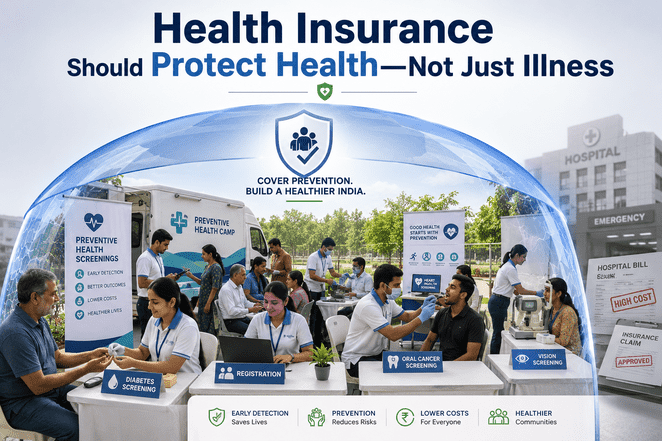
India’s health insurance system is built on a simple premise: something goes wrong, you make a claim. A surgery. A hospitalisation. A critical illness diagnosis.
What it largely doesn’t cover is the test that could have caught the problem three years earlier – or the doctor who explained the result at a health camp in a factory in Chhattisgarh – or the 30-day medication dispensed on the spot before a condition turned serious.
India’s out-of-pocket health expenditure still stands at nearly 40% of total health spending – one of the highest among major economies. And yet the one intervention that could reduce that number most effectively – structured preventive screening – remains almost entirely outside insurance coverage.
That has to change.
The Three Gaps That Need Addressing
Gap 1 – Preventive Health Tests Are Not Covered
Standard health and life insurance policies in India cover diagnostic tests only when linked to a hospitalisation or a treating physician’s prescription. Walk into a health screening camp, get an HbA1c test, an ECG, a breast cancer triage, or an anemia check – and none of it is reimbursable under most policies.
IRDAI’s updated guidelines do mandate certain annual or biennial health check-ups for policyholders – a step in the right direction. But this covers basic wellness checks for existing policyholders. It does not extend to community-level health screening programmes run for populations who may have no insurance at all – which is precisely where the burden is highest.
At Healium Camps, the tests we run are clinically serious – not wellness package tick-boxes. HbA1c for diabetes (the 3-month glucose average, not just a finger-prick). Thermalytix® for breast cancer – AI-powered, no radiation, instant triage. 12-channel ECG with specialist-reviewed cardiac reports in 8 minutes. Cervical cancer triage on-site. These are evidence-based, early-detection tests. Insurance should treat them as such.
Gap 2 – Doctor Consultations at Health Camps Are Unrecognised
Every Healium Camps medical camp includes qualified MD, MBBS and BAMS doctors conducting consultations – interpreting results, advising on next steps, and where applicable, prescribing treatment. Remote cardiac specialists review ECG reports in real time.
None of this consultation is recognised as a reimbursable medical service under standard health insurance, because it happens outside a registered clinic or hospital. The doctor is the same. The consultation is the same. The clinical value is the same. The setting is different – and that difference, for insurance purposes, erases the entire encounter.
This is a structural flaw, not a technicality. A doctor consultation that prevents a hospitalisation is worth more to the insurance system than one that follows it.
Gap 3 – On-Site Medicines Dispensed at Camps Are Not Covered
At our camps, where clinically applicable, we dispense treatment at the point of care. Hypertension – 30-day titration medication on the spot. Diabetes – up to 30 days of initial medication same day. Anemia – iron supplementation with 2x-3x higher bioavailability than standard formulations, handed over within the camp visit.
For most of the people receiving these medicines – daily-wage workers, agricultural communities, residents of semi-urban districts – this may be the only point in the year where they access a doctor and receive treatment together. Insurance coverage for these dispensed medicines would both validate the model and reduce the household health expenditure that follows when a condition is left untreated.
The Economic Case Is Not Complicated
Between 3% and 7% of Indian households fall into poverty each year due to high medical costs. The vast majority of those costs are treatment costs – hospitalisation, surgery, specialist care for conditions that reached a serious stage before being detected.
Covering a diabetes screening camp visit costs a fraction of covering a dialysis session. Covering an oral cancer screening camp costs a fraction of covering oral cancer surgery and chemotherapy. Covering on-site hypertension medication costs a fraction of covering a cardiac event hospitalisation.
The insurance sector’s reluctance to cover prevention is, in the long run, the most expensive policy choice it makes.
What We’re Asking For
We at Healium Camps are not asking for open-ended wellness benefits. We’re asking for three specific, measurable, auditable things to be covered under health and life insurance protocols:
- Evidence-based preventive screening tests conducted at structured, documented health camps by qualified professionals
- Doctor consultations at registered camp settings – treating them on par with OPD consultations
- On-site dispensed medicines for conditions detected and treated within the same camp visit
Our Healium Camps Ecosystem already produces the audit-compliant documentation that any insurer would need – disorder-wise records, dispensing logs, beneficiary data, doctor details, and timestamps. The infrastructure for covered prevention already exists. Insurance just hasn’t caught up to it yet.
IRDAI’s 2024 reforms have made health insurance more inclusive in meaningful ways – removing age limits, shortening waiting periods, expanding mental health coverage. The next frontier is preventive care at community level.
Prevention is not a wellness perk. It is the most cost-effective healthcare intervention available. It’s time India’s insurance protocols reflected that.
Frequently Asked Questions
Q1. Does health insurance in India cover preventive health tests?
Most standard policies cover diagnostics only when linked to hospitalisation. Community-level screening tests at health camps are largely not reimbursable under current protocols.
Q2. Are doctor consultations at health camps covered by insurance?
No – consultations outside registered clinics or hospitals are not recognised as reimbursable under most health or life insurance policies, regardless of the doctor’s qualification.
Q3. Why should insurance cover medicines dispensed at health camps?
On-site treatment at a health camp – for conditions like diabetes, hypertension, or anemia – prevents the far more expensive hospitalisation that follows if the condition goes untreated.
Q4. What has IRDAI done recently on preventive healthcare coverage?
IRDAI’s 2024 guidelines mandated annual health check-ups for policyholders and expanded coverage in several areas – but community-level preventive screening programmes remain outside formal coverage frameworks.
Q5. What documentation does Healium Camps produce to support insurance claims? Audit-compliant records of every camp – disorders detected, medicines dispensed, doctor consultations, beneficiary profiles – filterable by date, location, and disorder through the Healium Camps Ecosystem.
Q6. What is the financial argument for covering preventive health camps in insurance? Covering a screening test costs a fraction of covering the treatment for a condition detected too late. With nearly 40% of India’s health spending still out-of-pocket, prevention coverage is the most economically sound policy change available.
Planning a health camp? Get in touch with Healium Camps today – Click here.